
The Black Belt Trap
Why early promotions set high performers up to fail — and what to do instead

The fastest way to derail a top performer is to promote them before they’re ready. Not because they’ll fail at the job. Because they’ll fail at the title.
The Moment You Tie the Belt, the Clock Resets
I practiced Aïkido for ~7 years in my youth. I stopped around 16-17 years old. I never related to any particular lessons from my teachers after that until I became a manager. In Aïkido, there are two important moments:
When you get to the level where you can wear a Hakama (a traditional wide-legged black trousers)
When you get a black belt.
The moment when you get the right to wear a Hakama differs from Dojo to Dojo. In mine, it was before when you reached the level just before the black belt. When me an my brother were practicing for this exam, I remember our teacher telling us something fundamental: the Hakama and the black belt are not milestones. They are thresholds.
The moment you earn it, no one asks how long you trained or whether you tested early. A black belt signals one thing: you can perform at this level. A black belt for two days is held to the same standard as a black belt for five years. The dojo doesn’t grade on tenure. Neither do opponents.
The Hakama and the black belt are not milestones. They are thresholds.
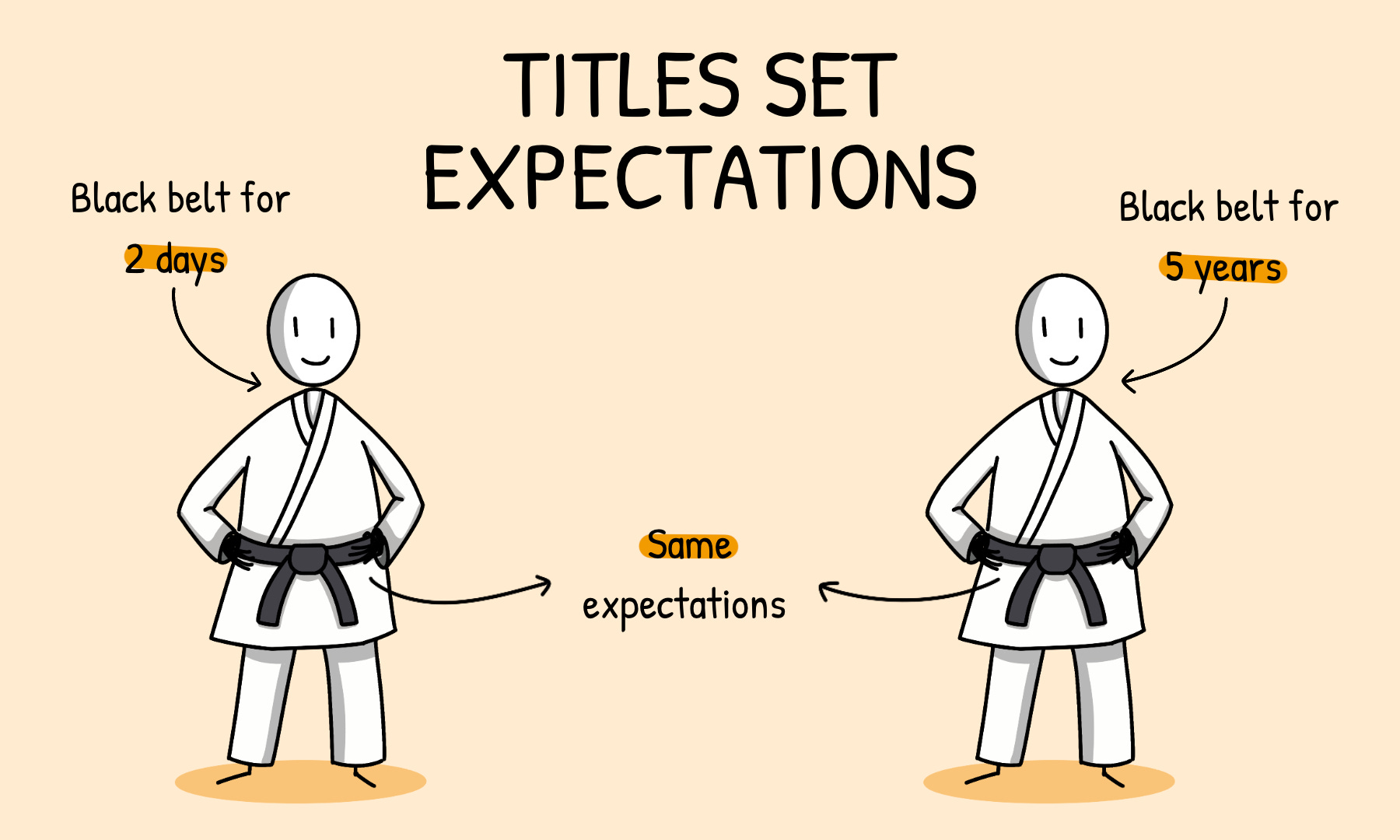
Work titles operate the same way, and most people never realize it.
When someone is promoted to Senior PM, or Principal, or Director, stakeholders don’t calibrate their expectations to “just promoted.” They calibrate to the title. The promotion is public, the context is private. What the organization sees is “the belt”.
This asymmetry is the black belt trap.
Promotions Feel Like Rewards. They Function Like Contracts.
There’s a widespread misunderstanding about what a promotion is for.
Most people experience promotions as recognition, a reward for strong performance at the current level. And they’re right that it’s backward-looking. You earned it. But what they miss is that the promotion is simultaneously a forward-facing contract with the organization.
The contract says: I will now operate at this level, consistently, starting now.
Not “I will grow into this level.” Not “I have potential.” The standard is immediate and public.
The most glaring example is when one becomes a team manager: you are trusted to manage people and get them to perform. If you never did that before, there is a high chance your performance will fall short of expectations. I know it because when I became a first-time manager at HelloFresh, having never managed anybody, I struggled. I got lucky to have a manager who trusted me and helped me get training. But you don’t want someone to train on the job with such responsibilities.
Note that this is not a quirk of corporate bureaucracy. It’s structural. Your peers at the new level have been there for years. Your new stakeholders have worked with many people in your role. Their pattern-matching for “what a [Senior PM / Director / VP] does” is calibrated to observed behavior over time. You are new to the title; they are not new to the expectations.
And be honest, you operate in the same way. How many of you compare your performance to peers at your level? All. And when someone gets to your level, but you feel they do not operate yet at this level, I bet your first reactions are “why did they get promoted?” and “If they have this title then I should get the next-level one”
The Fast-Track Paradox
Here’s where it gets counterintuitive and dangerous.
The people most at risk from early promotion are not underperformers. They’re the highest performers. Fast-trackers. The ones a manager champions because they show unusual capability. The ones everyone agrees are “ready.”
The logic seems sound: this person is exceptional, reward them, retain them, signal the organization’s confidence in them.
But “exceptional at the current level” and “ready for the next level” are different claims. Exceptional execution at L4 doesn’t automatically transfer to L5. The skills, scope, and judgment required often shift categorically, not just incrementally.
When a fast-tracked employee lands in their new role before they’ve built the full operating pattern for that level, three things happen simultaneously:
1. Stakeholder expectations are immediately calibrated to the title — No grace period. No onboarding curve. The belt is tied.
2. The employee operates from their strongest pattern, which is the old level — They do what made them exceptional, which is now insufficient or misaligned.
3. The gap reads as underperformance, not “new to the role” — Underperformance against the standard, not against a trajectory.
What was positioned as a reward becomes a setup. And in a particularly cruel inversion, the faster the promotion, the wider the gap.
You Cannot Be Promoted Into the Next Level. You Must Already Be There.
This is the principle most managers fail to communicate clearly, and most employees fail to internalize: The promotion is the recognition that you are already operating at the next level — not the permission to start.
This is not semantics. It changes everything about how you think about career development.
If you are targeting a promotion to Senior PM, the question is not “how do I get promoted?” The question is “Am I already doing Senior PM work, and is that visible?” If the answer to either part is no, you’re not ready. Regardless of how long you’ve been in the current role or how strong your last review was.
The black belt is a documentation of demonstrated capability, not a license to begin training for it.
The promotion is the recognition that you are already operating at the next level — not the permission to start.
This shifts the manager’s role, too. The job is not to promote people when they seem ready. It’s only to promote people who have already been operating at the next level, with enough consistency and breadth that the promotion is nearly a formality.
When a promotion feels like a risk, it’s too early.
What “Operating at the Next Level” Actually Looks Like
The phrase gets used a lot. It rarely gets defined. Leaving employees in utter confusion and thinking getting promoted is more like a Game of Thrones type of activity.
Here’s a useful test: could you describe what this person is doing at the next level, with specific examples, to a skeptical stakeholder, without hedging with “they have potential” or “they’re trending toward”?
If you need to invoke trajectory or potential, you’re describing the current level with optimism layered on top. That’s a different thing.
Operating at the next level means:
Scope: the person is already taking ownership of problems that belong to the next role, not just executing tasks within their current scope
Judgment: decisions made at the next level, not escalated up for them
Stakeholder trust: people at and above the target level already treat them as a peer, not as a report
Repeatability: not a single strong project, but a consistent pattern across contexts
The promotion makes the informal formal. It does not create the capability; it recognizes it.
The Readiness Grid
With all that being said, here’s a way to make this concrete. Imagine rating someone on the key dimensions of their current role and the next role with six levels levels:
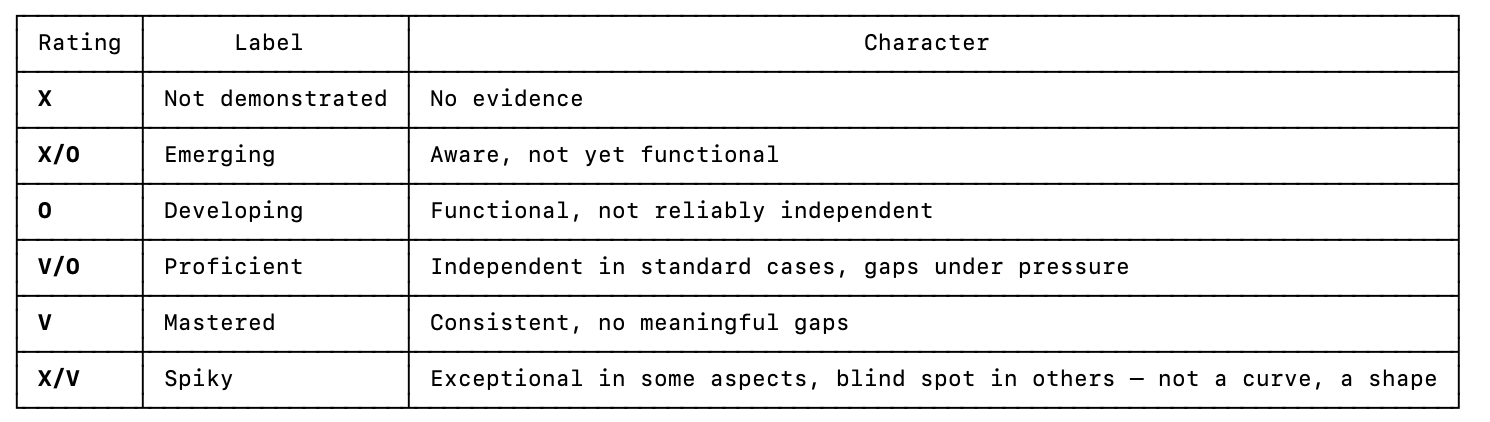
Roles share some dimensions, but the next level introduces new ones. Some dimensions are core — non-negotiable for the role. Others are secondary — important, but someone can grow into them after the promotion without causing immediate damage. That distinction matters when reading the grid.
In the tables below: “—” means the dimension doesn’t apply for that role while core dimensions are highlighted with a “*”
Pattern 1 — Still developing at current level. Not close.
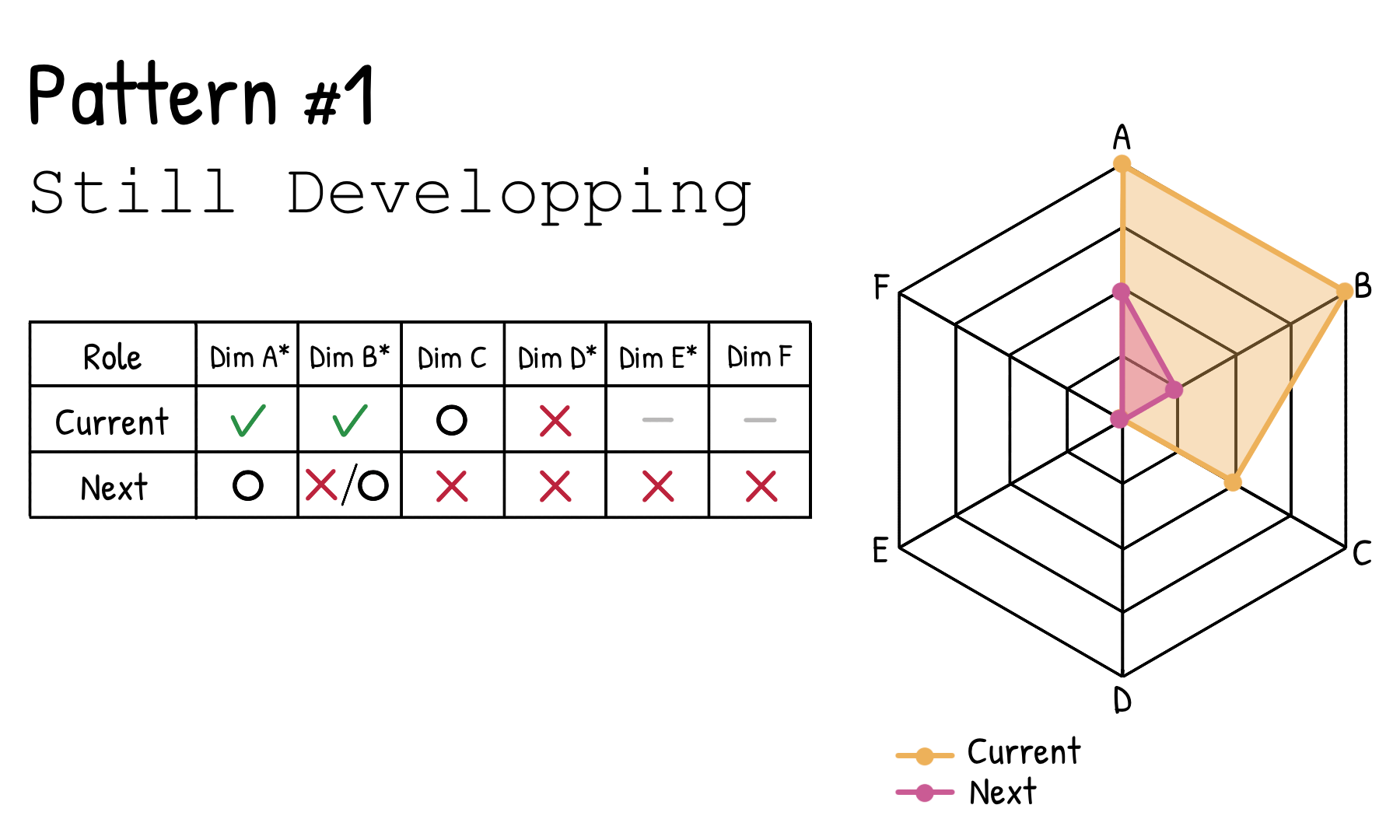
Still has gaps at the current level. Any conversation about promotion is premature.
Pattern 2 — The Black Belt Trap ⚠️
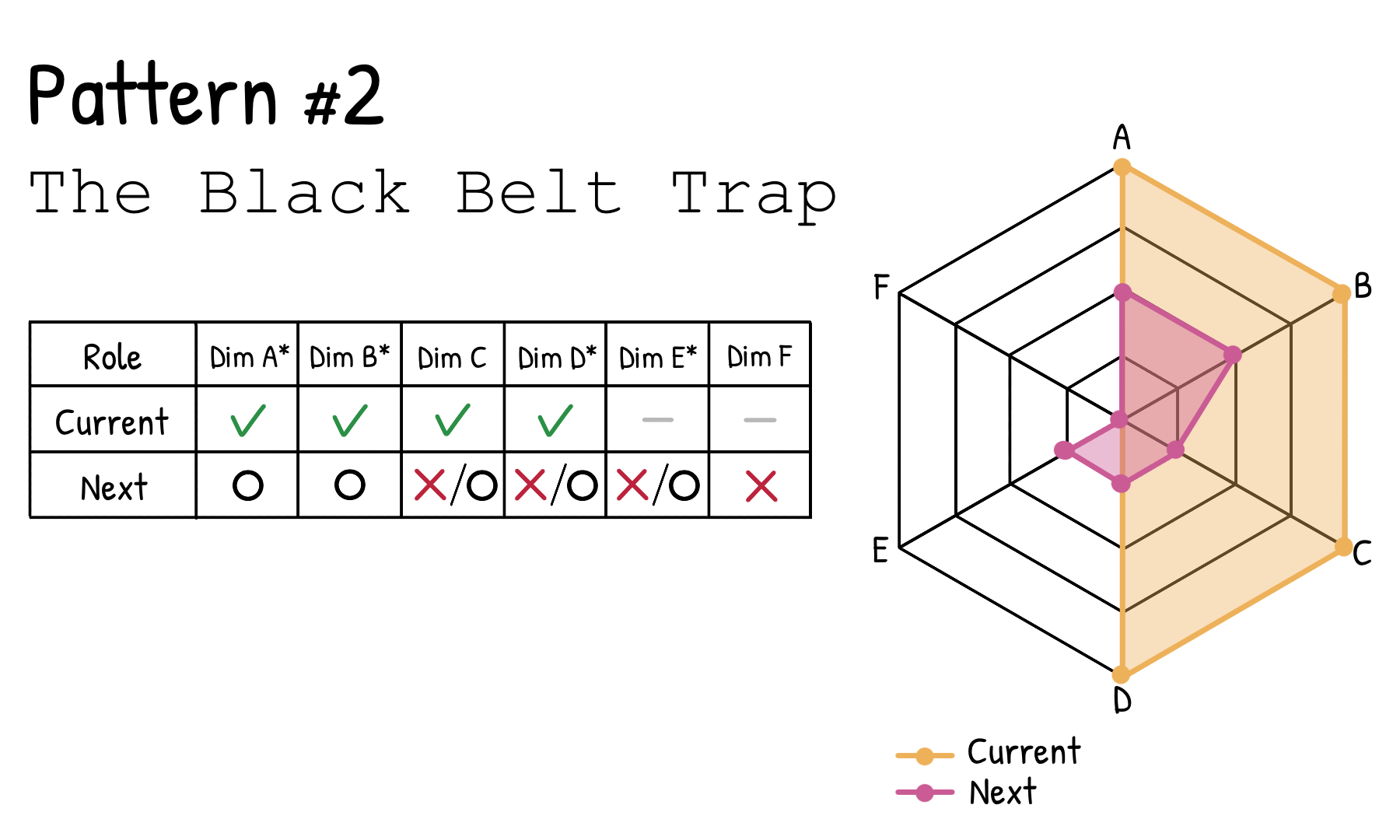
This is the dangerous one. All V’s in the current role — looks like a clear promotion candidate. But X’s across the board in next-level dimensions, including core ones. Promoting here means the person steps into a role they’ve never meaningfully operated in. Stakeholders will notice immediately. The fast-tracker becomes the underperformer.
Pattern 3 — Getting there. Not yet.
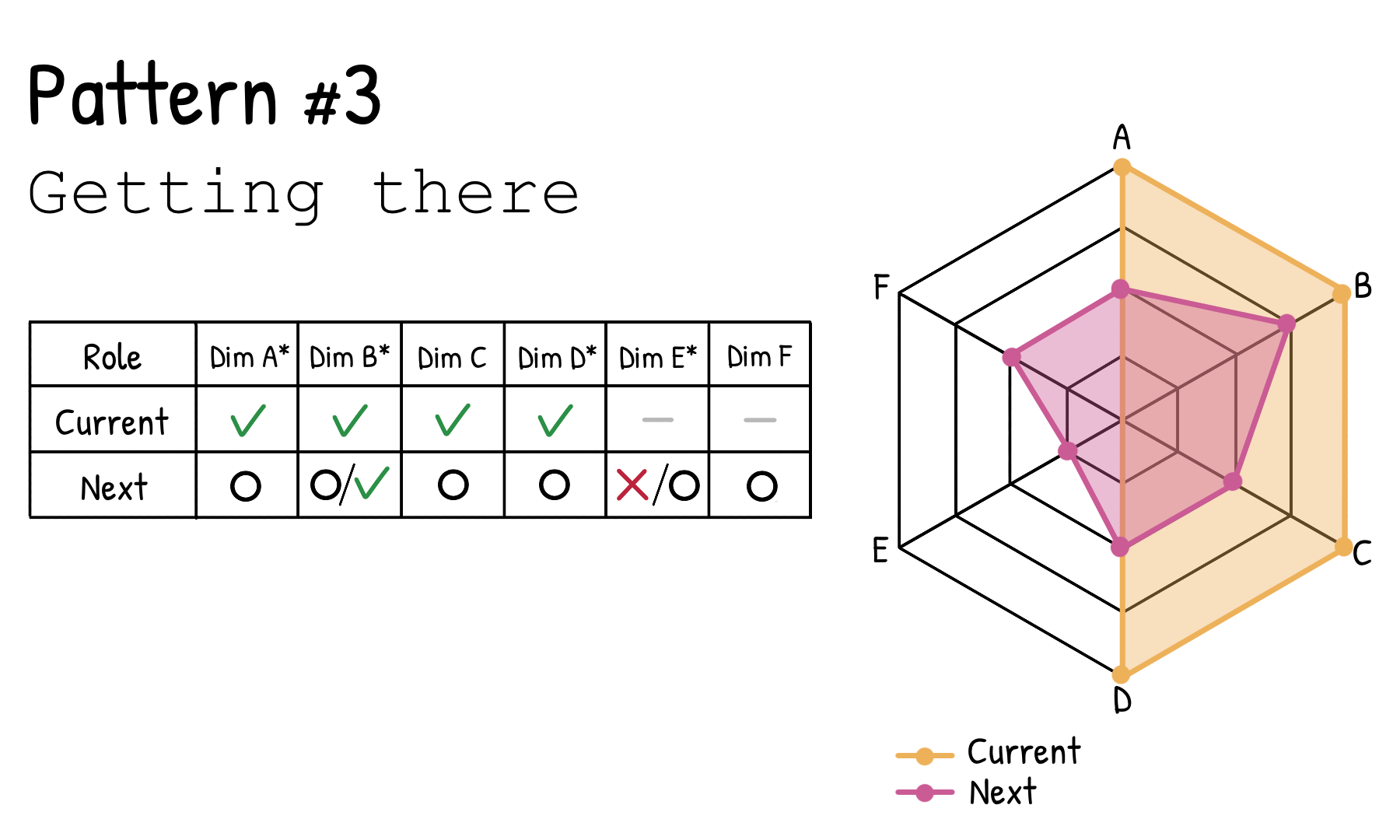
Much stronger. Current role fully mastered, next-level dimensions mostly at O or above. But Dim E — a core dimension — is still an X/O. That one gap in a critical area is enough to create real risk. The right call is to close Dim E before promoting, not assume it’ll develop on the job. If you do promote, the risk is yours to bear
Pattern 4 — Ready. The promotion is a formality ✓
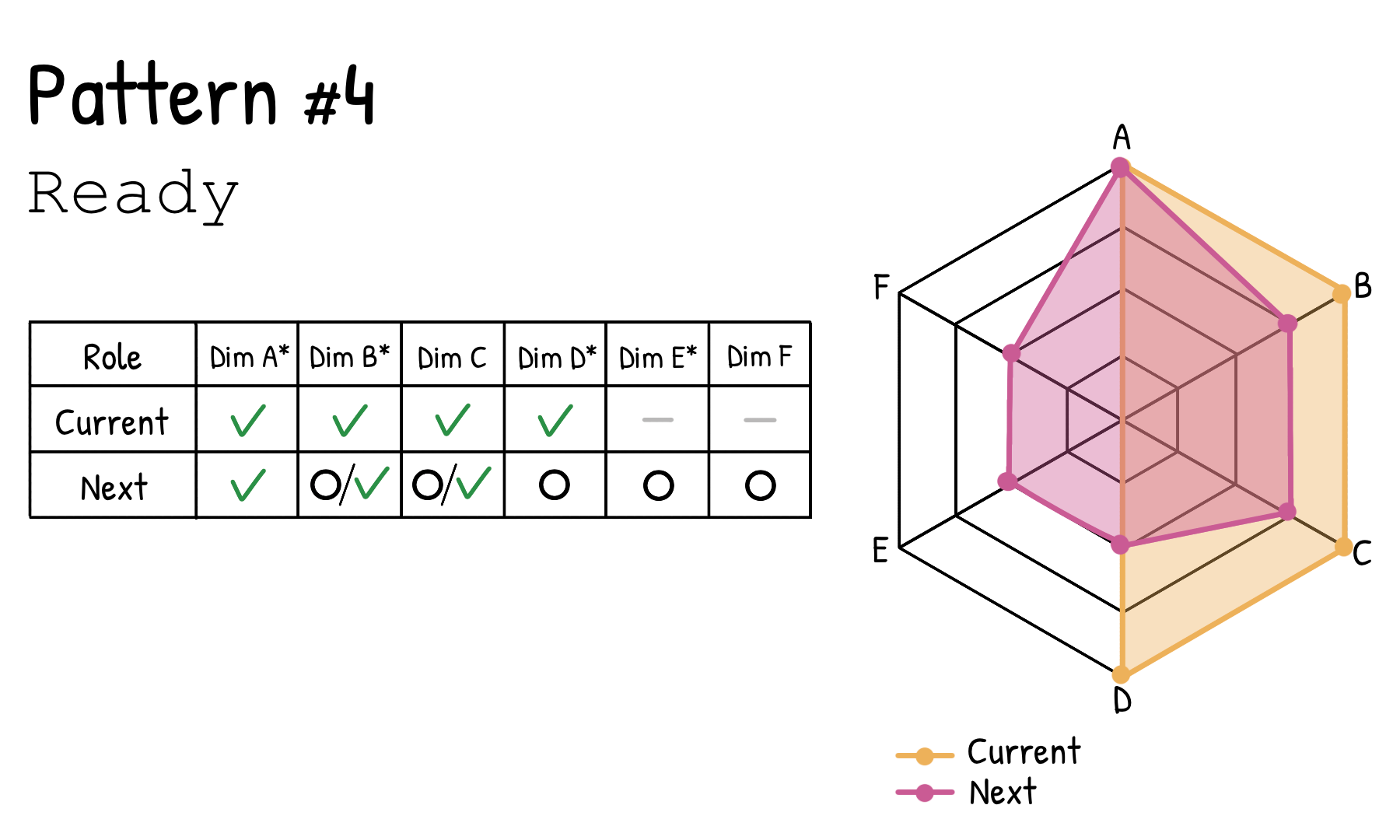
Current role fully mastered. Every next-level dimension at O or above, including all core ones. No X’s anywhere. This is the black belt moment: the promotion documents what the organization already knows. No risk, no gap, no adjustment period to manage.
Pattern 5 — Overdue. Retention risk
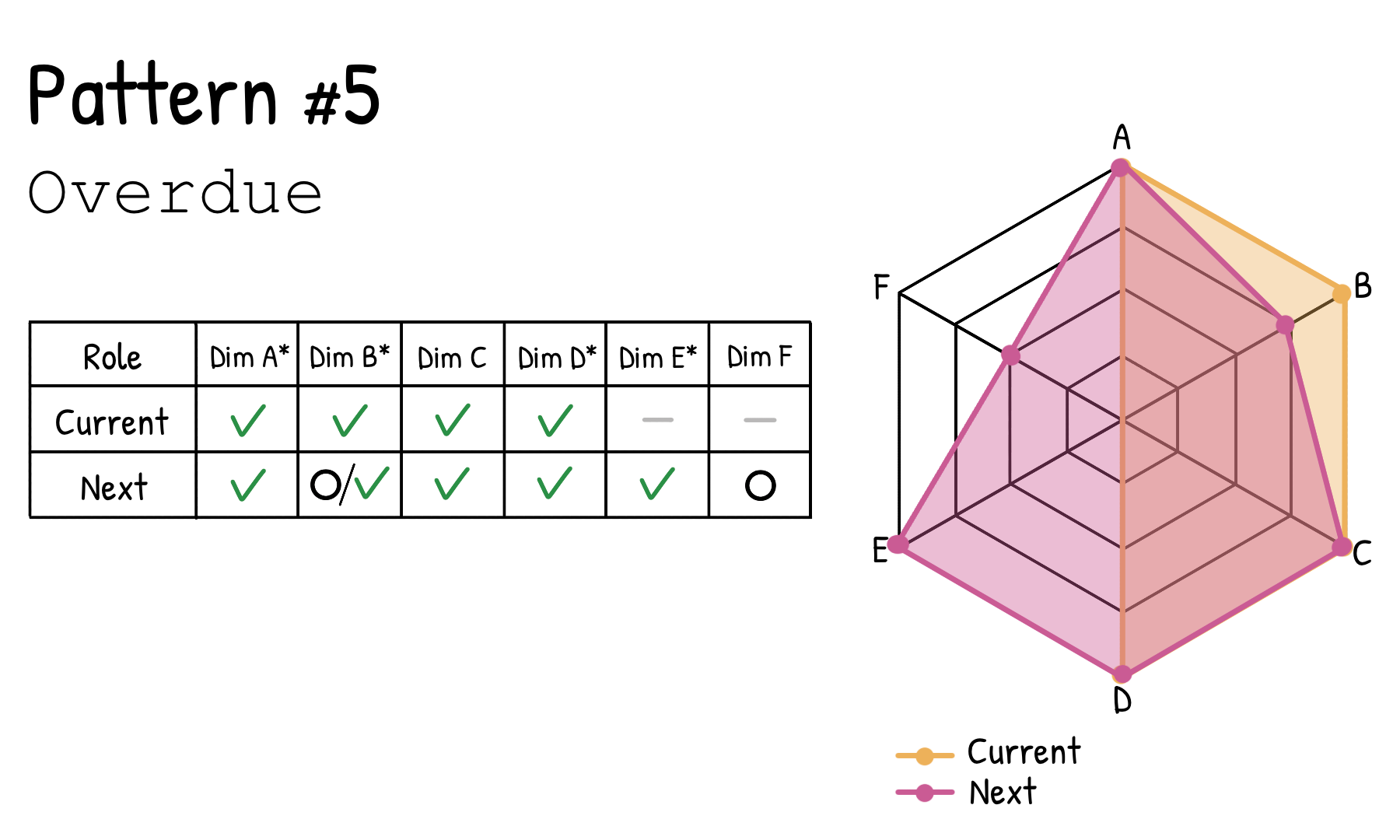
If you’re seeing this pattern, the person has already been doing the next role for a while. The promotion is late. At this point, the conversation isn’t about readiness — it’s about whether they still want to stay.
Two rules emerge from reading these patterns:
Rule 1 — No X’s in next-role core dimensions before promoting
An O means developing but functional. An X in a core dimension means the person has never meaningfully operated there. You cannot promote someone into discovering a critical blind spot.
Rule 2 — Current role must be all V’s or close
If there are still O’s or X’s in the current role, the person hasn’t finished where they are. Promoting them carries unresolved gaps into a harder context.
The safe promotion signal is simple: current role = all V’s, next role = no X’s in core dimensions.
Of course, every situation is unique, and in the borderline cases, you will have to assess whether an O, O/V, or X/V is not a problem to get promoted.
A final note on this method: in the simplified examples above, we rated dimensions, but I would encourage you to rate at the skills level (a dimension is made of several skills). From that, assign a number to each score (V=1, O/V = 0.75, O = 0.5, X/V = 0.4, X/O = 0.25, X = 0) and make the average (or weighted average if you have core skills vs non core skills) to compute the proficiency of a dimension.
What This Means for Managers and for You
If you manage people
The most dangerous thing you can do with a high performer is promote them before they’ve built the full operating pattern for the next level. Your instinct to reward and retain them is right. The timing is what matters. Give them real scope at the next level before the promotion — projects, decisions, stakeholder relationships that belong to that role. Let them earn the belt before you tie it.
And when you do promote, set context upward. Brief your stakeholders. Make sure the people who will work with them know the promotion was earned and ideally, have already witnessed it. The asymmetry of information is partly a manager’s problem to solve.
If you’re building your career
Stop optimizing for the promotion date. Start optimizing for being undeniably at the next level before anyone hands you the title. The fastest path to a durable promotion is to make it obvious, not to advocate for it.
Ask your manager: “What does operating at the next level look like — concretely? What would I need to be doing, consistently, for the promotion to feel like a formality?” If they can’t answer that with specificity, that’s important information too.
Conclusion
The black belt analogy holds because it makes the contract explicit. In martial arts, no one pretends the belt is a reward for effort or time. It’s a public signal of demonstrated capability. The moment it goes on, the standard is set.
Work titles deserve the same clarity from both sides of the conversation. I provided you with a method to make promotion evaluations more factual. A tool for your manager or your career builder to bring clarity into the gaps to the next level, and an occasion to focus where it matters.
Of course, none of this is worthy if you do not have a well-defined career ladder with roles, dimensions, and skills associated with them. If you are a manager and these do not exist, it is your role to create them with your HR team. If you are an IC and these do not exist, it is your duty to push for their creation so that you get a formalization of your career progression on which you can focus.
PS: It’s Monday — are you on top of last week’s performance?
If you are skipping your Weekly Business Review, lost in dashboards, or unsure why metrics move, you’re not alone.
📘 The Power of Analytics is your guide to choosing the right metrics and building a system to truly and easily understand product performance and customer behavior.
👉 Stop wasting your time and grab your copy here.